
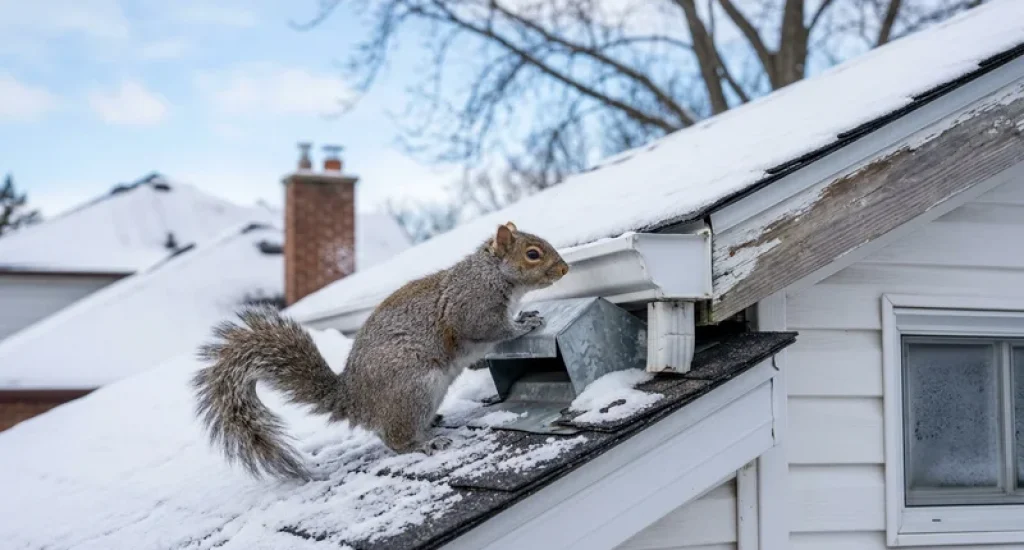
As the deep freeze of January 2026 settles over Southern Ontario, homeowners from Hamilton to Oakville are discovering that they aren’t the only ones seeking refuge from the sub-zero temperatures.
While much of our local wildlife hibernates, species like mice, rats, and squirrels remain active throughout the winter. When the Polar Vortex hits, their survival depends on finding a consistent heat source, and your attic is the ultimate prize.
The Heat Leak Magnet
Every home in Burlington or St. Catharines leaks a small amount of heat through roof vents, soffit gaps, and plumbing stacks. To a freezing squirrel or mouse, this rising heat is a beacon.
- Mice and Rats: Can detect a draft of warm air from a gap as small as a dime. Once they find it, they will gnaw at the entry point until it’s large enough to squeeze through.
- Squirrels: Unlike raccoons, squirrels do not hibernate. They are most active in the early morning during January as they forage for cached food. If they find a weakened fascia board or a plastic vent cover, they will chew their way into your attic to build a winter drey (nest).
The 2026 Rodent Surge: A Milder Winter Paradox
Early 2026 has seen fluctuating temperatures across the Golden Horseshoe. Paradoxically, milder winters often lead to higher rodent populations. Without a sustained deep kill freeze in late December, more juveniles survive into January. When the first true cold snap of the year arrives in mid-January, these larger populations all rush to the same residential structures at the same time.
Why DIY Poison is a Winter Mistake
In January, many homeowners reach for retail-grade rodenticides. At Bad Company Wildlife, we strongly advise against this for two reasons:
- The Odour Problem: If a mouse or rat eats poison and dies inside your walls during winter, the heat from your furnace will accelerate decomposition. Because your windows are sealed shut for the season, the smell becomes unbearable and nearly impossible to ventilate.
- Secondary Poisoning: Under Ontario’s 2025-2026 environmental guidelines, there is increased focus on the impact of rodenticides on local predators like owls and hawks. Our humane mouse removal focuses on exclusion and sealing, not chemicals.
Identifying Midnight Noise: Who is in Your Attic?
One of the most common calls we receive in January is: I hear something, but I don’t know what it is. Here is how to play detective:
- Scurrying & Squeaking (Nighttime): This is almost certainly mice or rats. They move through the wall voids (the spaces between your studs) and are most audible when the house is silent.
- Heavy Scratching & Gnawing (Daylight): If the noise happens at 7:00 AM or 4:00 PM, you likely have squirrels. You will hear them running laps across the top of your ceiling drywall as they move from the entry point to their nesting site.
- Slow, Heavy Thumping (Nighttime): While many raccoons sleep for long stretches in January, a warm spell can wake them up. Their movement sounds like heavy, deliberate footsteps.
The Hidden Danger: Electrical Fires
In the winter, wildlife damage goes beyond insulation. Rodents and squirrels are members of the family Rodentia, which means their incisors never stop growing. To keep them filed down, they must chew on hard materials. In an attic, the most attractive chew toy is often your electrical wiring.
The National Fire Protection Association (NFPA) estimates that rodents are responsible for 20% to 25% of all fires where the cause is categorized as “undetermined.”
Our Winter Search & Seal Process
Winter wildlife removal in Hamilton requires a specialized approach. Since we cannot always perform full roof repairs in a snowstorm, we focus on:
- High-Heat Inspection: Using thermal imaging to find where heat is escaping and where animals are nesting.
- Internal Trapping: Safely removing the current tenants from inside the structure.
- Temporary/Permanent Exclusion: Using heavy-gauge steel mesh to block entry points immediately, with a scheduled permanent repair once the spring thaw begins.
- Decontamination: Neutralizing the pheromone trails that rodents leave behind, which act as a scent map for other animals to follow.
Don’t Let Them Get Comfortable
Winter guests don’t just leave when the sun comes out. If a squirrel or mouse survives the winter in your home, they will use that same site to raise their first litter of the year in March.
Whether you are in Brantford, Niagara, or Hamilton, our team is equipped to handle winter infestations safely and humanely. Stop the damage before it spreads. Book your winter wildlife inspection with Bad Company Wildlife today.


