
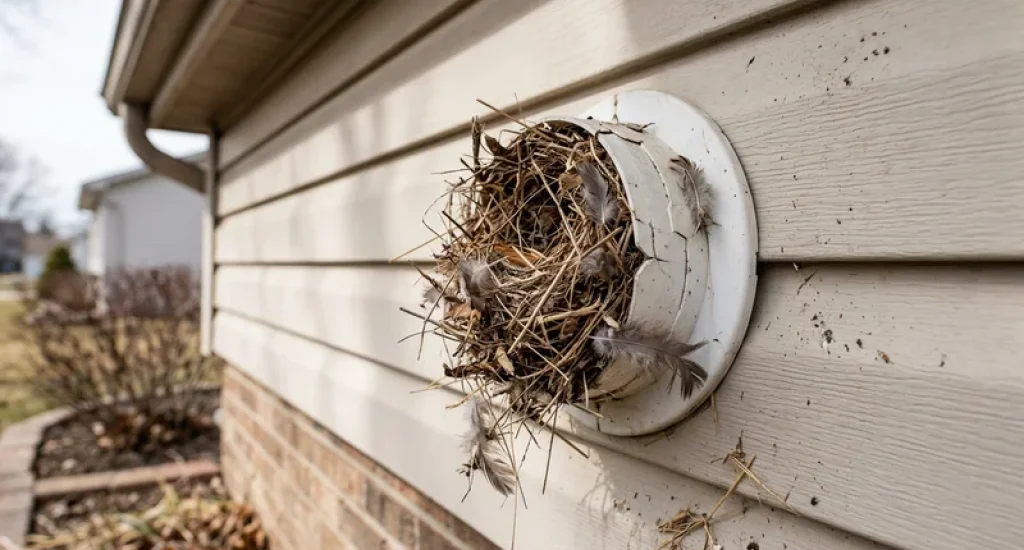
If you live in Hamilton, Burlington, or Oakville, you’ve likely noticed the neighbourhood starlings getting more aggressive. The scouting season is in full swing.
For a bird, your dryer or bathroom vent is a pre-heated, predator-proof cave. But for a homeowner, an avian tenant is a fire hazard, a health risk, and a legal deadlock. Here is why you need to act this month.
1. The 2026 Carbon Monoxide Safety Alert
Starting January 1, 2026, Ontario updated its Fire Code to require enhanced CO monitoring in residential homes. Why does this matter for bird nesting? If you have a gas dryer or water heater, a bird nest acts as a structural plug. When the exhaust cannot escape, Carbon Monoxide (CO), an odourless, colourless, and potentially lethal gas, backs up into your laundry room. A nest is not just a nuisance; it is a life-safety issue that can trigger your newly installed CO alarms in the middle of the night.
2. The Mite Migration: A Post-Fledging Nightmare
Many homeowners wait until the birds fly away to clean the vent. This is a dangerous mistake. Once the baby birds leave the nest in early summer, thousands of starving Bird Mites, tiny, 1mm parasites, will migrate away from the empty nest and crawl through your ductwork into your bathroom or bedrooms in search of a new host. By clearing and decontaminating the vent in March, you stop the infestation before it enters your home.
3. Understanding the Big Two: Starlings vs. Sparrows
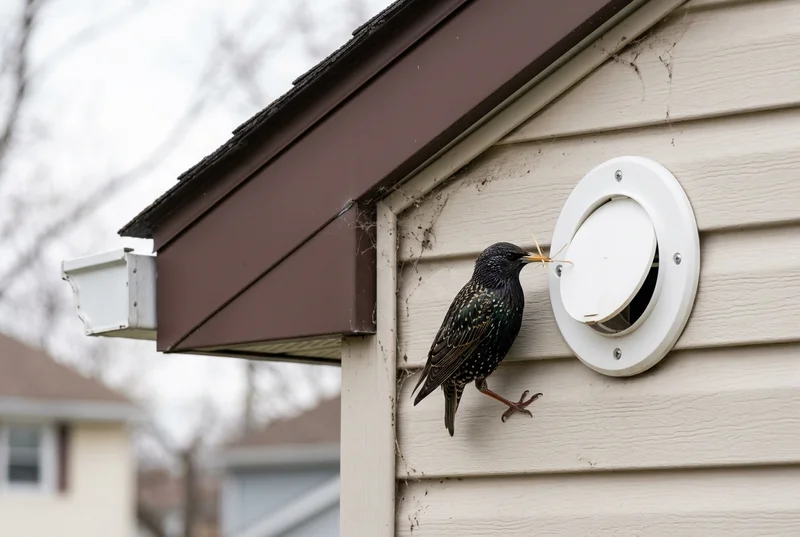
In Southern Ontario, the European Starling is your primary adversary. Unlike other birds, Starlings have evolved to use their beaks as levers; they can actually pry open the plastic flapper doors on your vents to get inside. House Sparrows, while smaller, are prolific, messy builders. They pack vents with an incredible amount of dry grass and feathers. Because they often raise 2-3 broods in a single season, a sparrow nest that starts in March will continue to grow and compact throughout the summer, eventually leading to a complete hard plug in your ventilation pipes.
4. HVAC Efficiency & The Dam Effect
A bird nest can block air. It can also force your equipment to work significantly harder. When a bathroom fan or dryer vent is obstructed, the motor must pull more amperage to push air past the dam.
- Mechanical Failure: This leads to premature motor burnout, which can cost $300–$600 to replace.
- Moisture Damage: Blocked bathroom vents trap humid air in your ceiling. By the time you see the mould spots on your bathroom paint, the birds have often caused thousands of dollars in attic moisture damage and rotted wood.
The Bad Company Bird-Proofing Process
Our bird removal strategy follows the Migratory Birds Convention Act, ensuring we stay on the right side of federal law.
- Industrial Vent Clearing: We don’t just pull out the front of the nest. We use high-pressure air tools to clear the entire duct length of flammable debris.
- Hospital-Grade Sanitization: Bird droppings are a primary source of Histoplasmosis, a respiratory fungus. We treat every vent with a medical-grade disinfectant to protect your indoor air quality.
- Galvanized Steel Guards: We install heavy-gauge, galvanized steel guards that allow air to flow while preventing bird entry.
The High Cost of the Wait-and-See Approach
Postponing this repair until April or May often leads to a massive jump in costs:
- The March Fix: A standard vent cleaning and bird guard installation is a straightforward preventive measure.
- The May Fix: If eggs are laid, we cannot legally remove the nest for 4–6 weeks. During this time, the heat from your dryer can bake and expand the nesting material, often bursting the flexible foil ductwork behind your drywall. Repairing internal ductwork and patching drywall can easily cost $1,000+ in labour.
Signs Your Vents Are Being Scouted
- Chattering in the Walls: If your bathroom fan sounds like a forest, a bird is already inside the housing.
- Debris on the Siding: Look for bits of straw or white-wash (droppings) directly below your exterior vent covers.
- Hovering Behaviour: If you see birds repeatedly hovering near your roofline, they have identified an entry point.
Beat the Birds This Season
Whether you are in Hamilton, St. Catharines, or Brantford, the time to secure your home is now. Once the first egg is laid, your vents belong to the birds for the rest of the spring.
Protect your home and your health. Contact Bad Company Wildlife today for a permanent bird removal and prevention solution.


